
 How can I help you?
One of the most confusing aspects of our work in mental health nutrition is biochemical individuality and how to assess it.
Let’s begin with a case example:
Two patients walk into your office with the same complaint. One has been sleeping poorly since a job change and feels anxious most days. The other describes the same insomnia, restlessness, and racing thoughts. They will not need the same intervention, and treating them identically is a missed opportunity.
Consider two patients presenting with anxiety, insomnia, or depression. Their symptoms may appear similar, yet the underlying mechanisms may differ considerably. One may have impaired nutrient absorption due to GERD, or inadequate cofactors, like B6 for neurotransmitter synthesis. Another may have altered receptor sensitivity due to years on psychotropics, chronic inflammatory activity, disrupted methylation due to MTHFR, or stress-related changes in neuroendocrine regulation because of years of stress.
The same symptoms do not necessarily reflect the same biochemical disturbances.
That observation sits at the heart of biochemical individuality, and it is fundamental to personalized treatment in integrative mental health care.
What biochemical individuality means
Biochemical individuality means that each person has a unique metabolic and physiological response to nutrients, foods, medications, botanicals, stress, and environmental exposures.
These differences explain why the same intervention can produce dramatically different outcomes in different people.
We share the same basic biochemical pathways. What differs is the activity running through them. Genetics, epigenetics, nutritional status, enzyme function, gut microbiota, hormonal regulation, inflammation, medication exposure, and life experience all shift how those pathways operate in each body at a given moment.
Why the same symptoms point to different mechanisms
Neurotransmitter function does not depend simply on the availability of precursor amino acids. It depends on the enzymes, cofactors, transport mechanisms, receptors, and regulatory processes that govern synthesis, signaling, and degradation.
A patient with plenty of serotonin precursor but impaired conversion to active serotonin needs a different approach than a patient who is genuinely short on the precursor. A patient whose HPA axis has been dysregulated for years is unlikely to be corrected by a supplement that assumes the problem is substrate availability alone.
This is why understanding metabolic pathways matters. Identifying which neurotransmitter might be involved in a symptom is a starting point, not an answer.
The clinical objective is not simply to identify which neurotransmitter might be involved in a symptom. It is to understand the interacting pathways that influence its function in a particular individual.
The variables that create the difference
Genetics and enzyme polymorphisms determine how efficiently a nutrient is converted or a medication is cleared. Epigenetics determines how responsive those pathways are to experience. Nutritional status determines whether the raw material is present at all. Gut microbiota produce metabolites that act directly on the nervous system. Hormonal regulation, including ovarian, testicular, thyroid, and adrenal signaling, shifts neurotransmitter synthesis and receptor sensitivity in both directions. Inflammation alters both synthesis and clearance. Medication exposure can occupy a pathway, deplete a cofactor, or change hepatic metabolism. And life experience, particularly chronic stress and trauma, changes neuroendocrine regulation itself.
None of these variables is exotic. All of them are common, especially in our clinical population, where people have often suffered for years without any good answers. Together they explain why two people can present identically and need opposite interventions.
The variable response problem
Biochemical individuality also explains why a nutrient, botanical, or pharmaceutical intervention may benefit one patient, produce little effect in another, or cause adverse effects in a third.
This is the practical case against standardized protocols. This is why, in my book Nutrition Essentials, I give primary, adjunctive, and optional protocols, since it’s a human puzzle. A protocol designed for the average patient is, by definition, wrong for a substantial minority. Response becomes a clinical data point rather than a verdict on the patient or the intervention.
It also reframes partial or absent response. A disappointing trial result is not only a question of dose or duration. It is information about which pathway was addressed, and which was not.
Brief Case
I am working with an 11-year-old girl. History of ODD diagnosis (not one of my favorite Dx’s!) and on three psychotropics since she was 7, and she’s on a high-carb and plant-based diet. Always hungry, always anxious. My analysis showed she needed a lot of purines: she metabolizes glucose very quickly (hence always hungry); she needs high-purine meats and seafood, alongside vegetables, fruits, low carbs, and more fats. Glutamine to absorb nutrients better, plus omegas and lots of GABA-rich foods and herbs. Within 10 days of changing her diet to address her metabolic individuality, things started to turn around. After 1 year, she is off all psychotropics, sleeping well, managing breakthrough anxiety at times, and feels nourished and satisfied.
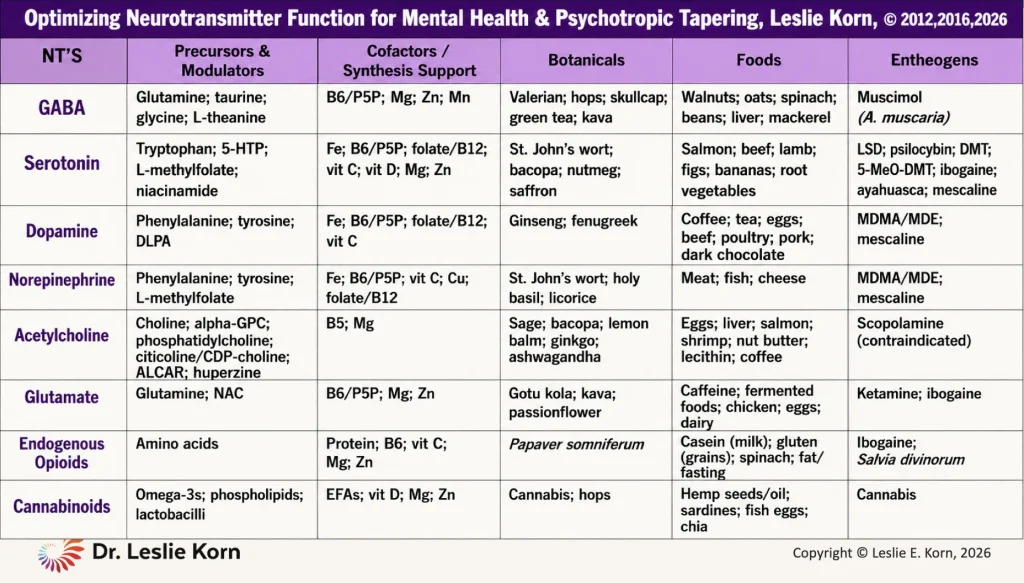
My Table 8.1 in Nutrition Essentials provides a framework for examining these relationships across neurotransmitters, nutrients, botanicals, foods, pharmaceuticals, and entheogens. It is a single reference for intersections that are otherwise taught and applied in isolation.
Why I created this chart
I created Table 8.1, Neurotransmitters, Neuromodulators, and Their Precursors, for my book Nutrition Essentials to help clinicians understand the complex biochemical relationships underlying mental health and translate that knowledge into individualized clinical care.
Too often, neurotransmitters are discussed in isolation, as though an excess or deficiency of a single brain chemical can explain depression, anxiety, insomnia, or cognitive difficulties. Neurotransmitter function depends on interconnected metabolic pathways involving amino acids, nutrients, enzymes, cofactors, receptors, and regulatory mechanisms. I wanted to bring those relationships together in one practical reference, showing how nutrients, foods, botanicals, pharmaceuticals, and entheogens intersect with neurotransmitter systems.
The chart also reflects a fundamental principle of integrative medicine for mental health: biochemical individuality. We share common biochemical pathways, but we don’t all metabolize nutrients, respond to medications, or regulate neurotransmitters the same way. Genetics, nutritional status, gut function, inflammation, hormonal activity, stress, trauma, and environmental exposures influence how those pathways function in each person.
I created this chart to encourage clinicians to think in pathways rather than isolated symptoms, and in individuals rather than standardized treatment protocols.
It is not a diagnostic instrument and not a formula for selecting treatments. It is a framework for asking better clinical questions, recognizing biochemical relationships, and understanding why personalized approaches to mental health care matter.
Using the framework in practice
• Work from the pattern rather than the label. A symptom is a description of a pattern in time, not a mechanism.
• Ask what is driving this patient’s version of it. The same insomnia may be driven by cortisol dysregulation in one patient, reactive hypoglycemia in another, and perimenopausal sleep disruption in a third.
• Treat the system, not the endpoint. Supporting one pathway while another remains blocked produces partial or unpredictable results.
• Expect variable response and read it as information. Minimal effect is data about the pathway, not a character judgment about the patient or the intervention.
• Keep the whole person in view. Sleep, stress, trauma history, nutrition, medication, and social context are not separate from the biochemistry. They are inputs to it.
Why does this matter?
We are moving toward precision in mental health care. We have already been supporting our clients/patients with precision, interpersonally. Now we are becoming more precise biochemically.
When clinicians work in pathways rather than symptoms, and in individuals rather than averages, personalized care becomes the norm we align with.

She served as a Fulbright scholar on traditional medicine, a Clinical Fellow at Harvard Medical School, and a National Institutes of Health-funded research scientist in mind/body medicine.
- Biochemical Individuality: Why Identical Symptoms Need Different Treatment - November 18, 2026
- Ashwagandha: Traditional Uses, Health Benefits, Dosage, and Safety - November 9, 2026
- Understanding Cannabis Ratios and Delivery Methods - October 28, 2026

Are You Ready to Advance Your Career?
If you want to advance your career in integrative medicine, explore my courses and certifications.